This Is Your Brain on Uncertainty And Why It's Ruining Everything

More freedom doesn't always equal more peace.
Optimists? Surprisingly fragile.
Chasing happiness is basically running from it.
Fighting your feelings just makes them thrive.
Trying to control your anxiety is basically throwing gasoline on it.
The thing you're most afraid to show people is the very thing that connects you most deeply to them.
Six statements. All of them feel like they shouldn't be true. All of them are. AND have been proven, studied, and lived by real people navigating real life.
These are paradoxes and the human brain, by design, was never built for them. We're wired for pattern recognition, cause-and-effect, and clean resolution. For most of our evolution, uncertainty got you killed. There was no room for "well, that saber-tooth tiger and I have a complicated relationship." You ran or you didn't.The idea that two contradictory things can both be completely true? That's not just feeling uncomfortable. To your nervous system, it registers as a threat. Not metaphorically, but literally. The same system that once scanned dark forests for predators is now scanning your relationships, your decisions, and your unresolved emotions for danger. It doesn't know the difference between a saber-tooth tiger and an unanswered text. It just knows: unclear = unsafe. And it will do everything in its power to make the unclear, clear. Even if that means oversimplifying, catastrophizing, or shutting down entirely.
Here's what the science says about why your brain fights paradoxes so hard, and what it looks like to stop fighting back.
Why Your Brain Wasn't Built for This
Before we go further, let's be honest about something: your brain is not trying to make you happy. It never was.
Your brain's primary job is to keep you alive. And for most of human history, survival meant fast, clear answers. Is that a threat or not? Run or stay? In or out? Ambiguity was dangerous. Certainty kept you breathing.
That ancient wiring is still running the show today, even long after the threats changed.
When you encounter something uncertain, contradictory, or emotionally complicated, your amygdala fires as if it's a threat. Your cortisol rises. Your nervous system pushes hard toward resolution. It needs you to pick a side, collapsing complexity into something simple, getting a clear answer even if that answer is incomplete or just plain wrong.
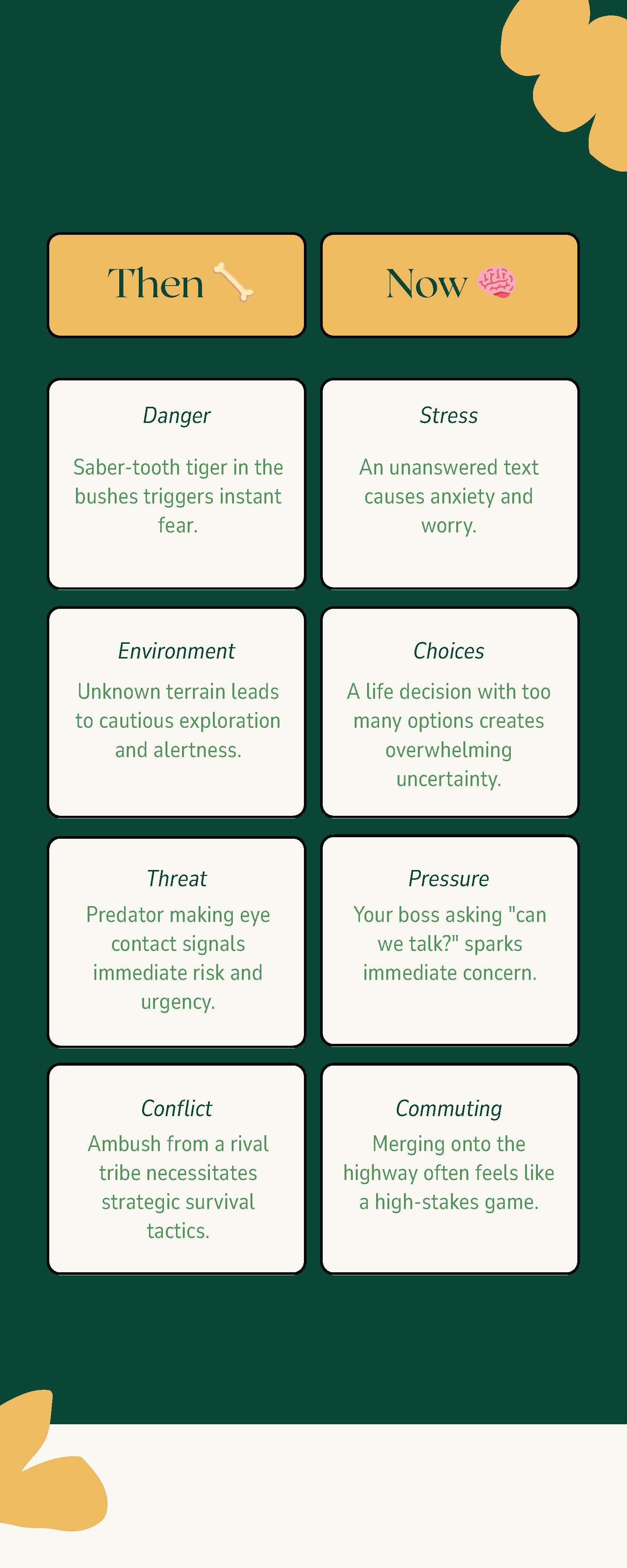
Researchers call this intolerance of uncertainty, a term developed by psychologist Michel Dugas and colleagues at Laval University (Dugas et al., 1998). It's one of the most significant drivers of anxiety, overthinking, and black-and-white thinking we see today. When we can't tolerate not-knowing, we'll do almost anything to make the discomfort stop. We will convince ourselves of things that aren't true, staying in situations that aren't healthy, or suppressing emotions that really need to be felt.
Your brain isn't broken. It's just running very old software in a very complicated world.
Ambivalence Is Not a Problem to Solve
Here's one of the most liberating reframes in mental health: ambivalence is not confusion. It's complexity.
Our culture, and often our own inner critic, tells us to figure it out. Pick one. Move on. Stop going back and forth. But what if the most emotionally intelligent response to certain situations isn't resolution? What if it's simply presence?
When you love someone who has also hurt yo… that’s not weakness or poor judgment. That's two real things being true at once.
When you desperately want to change but are terrified of what change might cost you… that’s not self-sabotage. That's your nervous system doing exactly what it was designed to do.
When you feel proud of how far you've come and still grieve how hard the road was… that’s not ingratitude. That's depth.
Dialectical Behavior Therapy (DBT) is built on this exact idea — called dialectical thinking — the ability to hold two seemingly opposite truths without forcing them into agreement or declaring one the winner. It's one of the most effective frameworks for people navigating intense emotions, difficult relationships, and the messiness of real life.
Not because it makes things easier. Because it makes things livable.
Sitting with Uncertainty Is a Skill. You Can Build It.
The good news in all of this is that tolerance for paradox and uncertainty isn't a fixed personality trait. It's not something you either have or you don't. It's a skill, and like any skill, it gets stronger with practice and intention.
Here's what that can look like in everyday life:
Notice the urge to resolve. When you feel that anxious pull toward a fast answer or a clear conclusion, pause before you act on it. Ask yourself: Am I rushing toward certainty because I have real clarity or because sitting with not-knowing feels unbearable right now? Just naming it can create a little space.
Name both truths out loud. Instead of "I shouldn't feel this way," try: "I feel _____ and I also feel _____." Say it. Write it down. Let both sentences exist without making one of them wrong. You might be surprised how much lighter that feels.
Get curious instead of afraid. Brené Brown often talks about choosing curiosity over the need for comfort. When something feels contradictory or confusing, try asking: What is this tension trying to show me? Paradoxes are often doorways. Not dead ends.
Let "I don't know" be enough for now. "I don't know" is not a failure. It's not a sign you're lost or stuck. In most therapeutic frameworks, it's actually the beginning of honest self-awareness. You don't have to have it figured out today.
Practice with small things first. You don't have to start with your biggest, heaviest paradox. Notice where you feel tension in small, everyday moments and practice just... observing it. Not fixing. Not deciding. Just noticing.
A Mature Mind Holds Tension
Research in adult psychological development suggests that the ability to think in complex, non-binary ways, or to hold tension without immediately collapsing it into something simpler, is a genuine marker of growth (Basseches, 1984). It's associated with greater emotional resilience, more authentic relationships, and a deeper capacity for empathy and self-understanding.
The people who seem most grounded, most steady, most genuinely at peace? They've usually learned (often through hard, disorienting seasons) that life is full of both/and. That healing is nonlinear. That strength and struggle can share the same moment. That uncertainty isn't the enemy of a good life. It's the terrain of one.
A mind that can hold a paradox isn't a confused mind. It's a mature one.
You Don't Have to Have It All Figured Out
If you walk away from this post with one thing, let it be this: you are allowed to be complicated.
You are allowed to be healing and still hurting. Hopeful and still scared. Moving forward and still grieving what was. Strong on the outside and quietly exhausted on the inside. All of it can be true at the same time, and none of it means something is wrong with you.
Learning to sit with two conflicting truths isn't about giving up on answers or resigning yourself to confusion forever. It's about trusting yourself enough to stay in the question a little longer. To let the tension teach you something before you rush to resolve it.
And sometimes that's exactly where the growth is.
At Our Community Counseling, we walk alongside people through the complicated, beautiful, hard, and hopeful parts of being human. If something in this post stirred something in you, we'd love to be part of your next step.
Contact us here to schedule an appointment.
Citations
Dugas, M. J., Gagnon, F., Ladouceur, R., & Freeston, M. H. (1998). Generalized anxiety disorder: A preliminary test of a conceptual model. Behaviour Research and Therapy, 36(2), 215–226.
Basseches, M. (1984). Dialectical Thinking and Adult Development. Ablex Publishing.